No Permit, No Problem: Inside the Guerrilla Screening Circuits Turning America's Dead Spaces Into Cult Cinema Temples
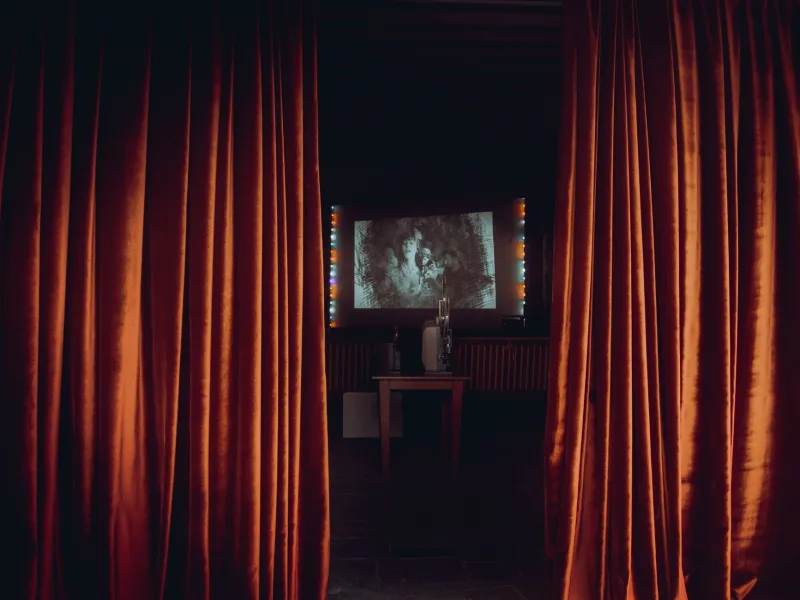
The address comes through a Signal message at 6 PM. By 7:30, you're standing outside a former garment factory in a post-industrial neighborhood that hasn't had a working streetlight in years, waiting for a door that's supposed to open at 8. There's no marquee. There's no box office. There's a guy named Marcus checking names off a list on his phone, and behind him, through a door that used to lead to a loading dock, sixty people are settling into folding chairs arranged in front of a 16-foot projection screen that definitely was not there this morning.
Tonight's feature: a 35mm print of Eraserhead that traveled here in a battered film case from a private collector two states away. The projector is a converted Elmo that Marcus bought off eBay and spent eight months learning to operate. The sound system is a pair of powered PA speakers that a friend of a friend uses for underground dance parties when they're not here.
This is the guerrilla screening circuit. It has no official name, no website, no press contact. And it might be the most vital space for cult film culture in the country right now.
Mapping the Invisible Network
What's happening in cities like Detroit, Philadelphia, New Orleans, Chicago, and Los Angeles isn't exactly organized — which is partly the point. Guerrilla screening communities operate through trusted social networks, encrypted messaging apps, and the kind of word-of-mouth infrastructure that predates the internet. There's no central directory. Getting in means knowing someone who knows someone, or stumbling into the right conversation at the right record store or zine fair.
But the scale is larger than most people realize. Organizers and attendees who spoke with Neon Reels Club — almost all of whom declined to be identified by full name — describe active screening communities in at least fifteen major US cities, with smaller operations in college towns and mid-sized markets that most entertainment coverage ignores entirely. Some run monthly. A few run weekly. One operation in a Midwestern city has been holding bi-weekly screenings in the same basement location for six years without a single incident.
The programming skews heavily cult: exploitation double features, international horror, obscure sci-fi, underground animation, midnight movies that never got a proper restoration. These are not films you can find on Netflix. Several of them barely exist on any licensed streaming platform at all.
The Legal Gray Zone
Let's be direct about what's happening here, because the people involved are surprisingly candid about it: showing a film in a space without the proper public performance license, fire permits, occupancy clearances, and in many cases without the rights holder's knowledge is illegal. The exposure ranges from civil copyright liability to municipal code violations to, in some jurisdictions, misdemeanor charges related to unlicensed public assembly.
Organizers manage this risk through a combination of strategies. Many operate on a donation or suggested contribution model rather than selling tickets — a distinction that provides thin but real legal cover in some states. Others run their events as nominally private gatherings, technically inviting guests rather than selling admission to the public. A few simply accept the risk as part of the operation's identity.
"We're not trying to rip anyone off," says one organizer who runs a screening collective in the Mid-Atlantic region. "We're showing films that nobody is actively licensing to anyone, in a space that would otherwise be sitting empty, for people who genuinely love this stuff. If the rights holder showed up and said stop, we'd stop. Nobody has ever shown up."
The reality is that enforcement is rare. Rights holders for obscure cult titles are often individuals or small estates with no active licensing infrastructure. Municipal authorities have bigger problems than a basement showing Suspiria to forty film nerds. The risk is real but diffuse, and the communities that have survived longest are the ones that stay small, stay quiet, and stay moving.
Why These Rooms Feel Different
Ask anyone who's attended a guerrilla screening why they keep going back, and the answers converge on something that's hard to quantify but immediately recognizable: the room is alive in a way that commercial exhibition rarely achieves.
Part of it is selection. Every film shown in these spaces was chosen by a human being with a specific vision — not surfaced by an algorithm, not programmed to satisfy demographic data, not selected because it fit a pre-existing franchise relationship. The curator has a point of view, and the audience knows it and trusts it.
Part of it is community. The people in these rooms are self-selected to a degree that mainstream cinemas can't replicate. Everyone present found their way here through some combination of genuine obsession and social trust. The shared context changes how the film lands.
And part of it — a significant part — is the physical conditions. Imperfect projection. Ambient sound from the building. Chairs that aren't quite right. The sense that the space itself wasn't built for this, which makes the fact that it's happening here feel meaningful rather than routine.
"There's something about watching a movie in a place that wasn't supposed to be a movie theater," says one regular attendee who's been part of the scene in two different cities. "It feels like the film is getting away with something. Which is exactly how the best cult movies feel anyway."
What the Streaming Era Made Necessary
The proliferation of streaming platforms was supposed to democratize access to film culture. In some ways it did. In other ways, it created new scarcities — of curation, of physical community, of the specific experience of encountering a film in a room full of people who chose to be there.
The guerrilla screening circuit is, at least partly, a response to those new scarcities. It's filling gaps that the streaming model structurally cannot fill: the gap between licensing and availability, the gap between algorithmic recommendation and human curation, the gap between watching alone on a couch and being in a room where the person next to you is feeling exactly what you're feeling.
Whether that's enough to sustain a movement long-term is an open question. These operations run on volunteer labor, borrowed equipment, and the continued willingness of participants to accept real legal and logistical risk. They're fragile by design.
But on a Tuesday night in a former loading dock, with Eraserhead filling a screen that wasn't there this morning and sixty people who found their way here through whisper networks and encrypted messages, fragile feels like exactly the right word for something worth protecting.